/ PUBLICATION, DUAL-USE
Report: "Barriers to the Development of Dual-Use Technologies in Poland"
Center for Defense Security and Innovation
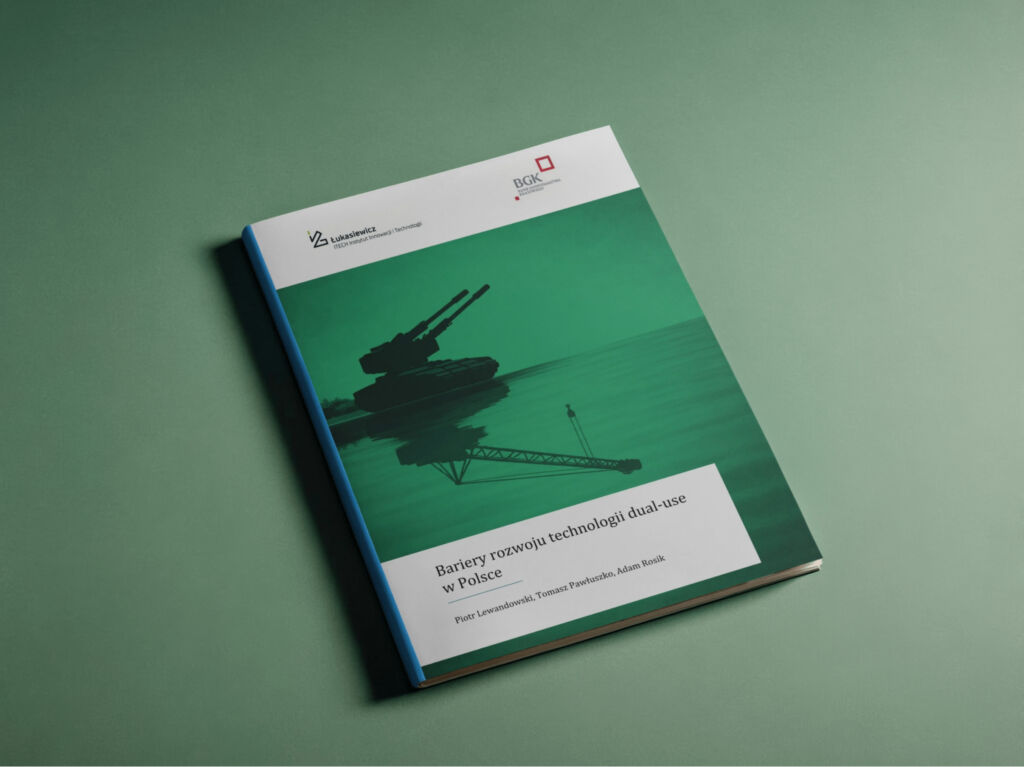
We have the technology, but we lack coordination. This report identifies the shortcomings of Poland’s dual-use ecosystem.
Dual-use technologies—that is, solutions with both civilian and military applications—are one of the pillars of technological security for modern states and should be viewed as a tool for advancing economic, innovation, and industrial policies.
Artificial intelligence, 3D printing, advanced sensors, quantum technologies: these are no longer the future of defense, but its present. Poland possesses the expertise and research potential in these areas. The problem is that this potential is often not utilized where it could yield the best results. The identified shortcomings, according to the authors— Dr. Piotr Lewandowski, Dr. Tomasz Pawłuszko i MSc Eng. Adam Rosik – are structural in nature and relate to the way in which the state designs, manages, and adopts innovations of strategic importance.
Contrary to popular belief, the main problem does not seem to be a lack of funds or inappropriate regulations, but rather the state’s flawed institutional architecture. The institutions responsible for funding research, testing technologies, and procuring defense solutions operate in separate silos, without coordination mechanisms covering the entire innovation cycle—from prototype to operational deployment.
The result? Technologies that reach TRL levels 4–6 (working prototype) get stuck in the so-called “valley of death.” There is no system in place to guide them to the operational procurement stage.
The report “Barriers to the Development of Dual-Use Technologies in Poland” identifies regulatory, operational, financial, organizational, technological, and sociocultural barriers. These are different facets of the same problem: the lack of integration between funding, testing, and public procurement means that technological potential does not translate into actual defense or economic capabilities.
As the authors write, “The study’s findings reveal systemic weaknesses in the ecosystem in Poland and the EU, where regulations are perceived as overly bureaucratic and ill-suited to innovation, infrastructure and funding fail to keep pace with testing and implementation needs, and institutions operate in silos without dedicated coordination.”