/ PUBLICATIONS
Center for Defense Security and Innovation
Barriers to patent commercialisation require a multifaceted approach. An expert commentary by M.Sc. Eng. Adam Rosik from the Centre for Security and Defence Innovation at the Lukasiewicz Institute of Technology and Innovation.
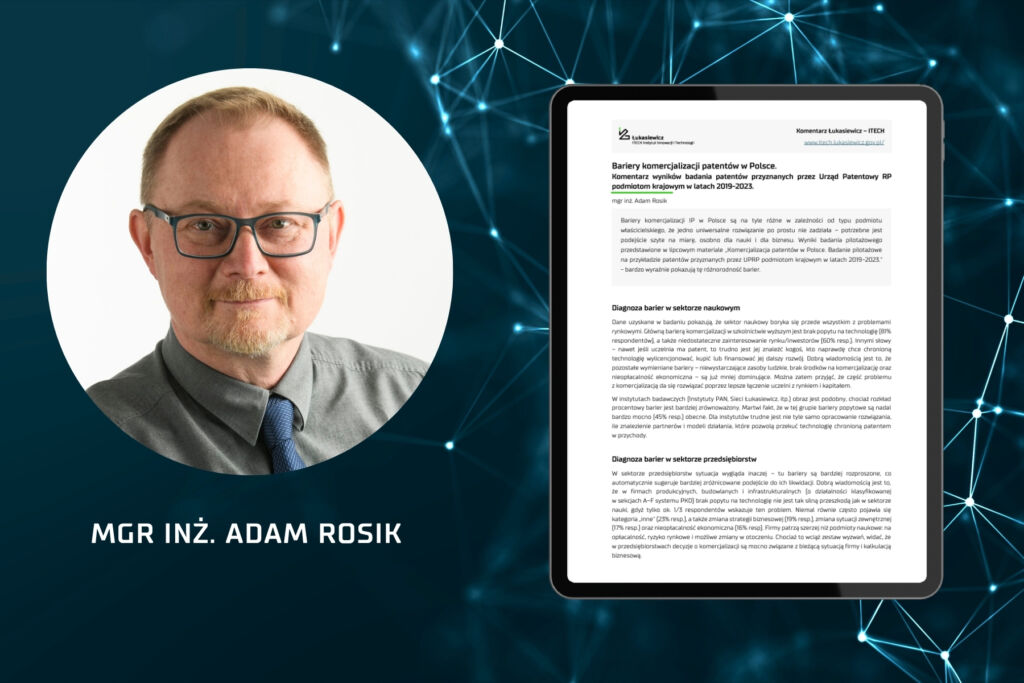
From the perspective of industrial property commercialisation, the results of the first pilot study regarding the future of patents granted by the Polish Patent Office show that support instruments should consider the specifics of different groups of entities. According to the results of the study carried out with the participation of the Polish Patent Office, SGH and GUS are mentioned in the latest expert commentary by MSc Eng. Adam Rosik from the Łukasiewicz – ITECH Centre for Security and Defence Innovation
The commercialisation of patents runs into different barriers depending on the type of entity that owns them. As indicated by Adam Rosik, effective support for the transfer of technology requires moving away from one universal model in favour of the individual adjustment of solutions to the sectors of science and business.
- In the science sector, problems mainly revolve around access to market and capital. In higher education, the most frequently reported barrier appears to be the lack of demand for technology – reported by 81% of respondents. Another significant problem is the insufficient attention paid by the market and investors, noted by 60% of those surveyed. In the case of research institutes, barriers are more so evenly distributed, although problems related to demand remain significant.
- Within enterprise, the situation appears more diverse. In manufacturing, construction, and infrastructure companies, lack of demand for technology accounts for around one third of respondents, and other barriers include changing business strategy, changing external conditions, and economic unprofitability. This means commercialisation decisions are more closely linked to the company’s current situation, risk assessment, and business calculations. Somewhat differently does the situation appear in businesses of the service industry. After the lack of demand for technology, other frequently mentioned problems are the limited engagement by investors and lack of financial resources. Simultaneously, firms must deal with market, capital, and financial constraints.
The study results also show the scale of untapped potential. Of the patents analysed, only one in four was commercially exploited, most often directly by the owner. At the same time, 64.7 percent of all patents analysed remain outside the market.
According to Adam Rosik, the diagnosis of barriers is an important entry point for designing effective support mechanisms for the commercialisation of intellectual property. The next step should be to adjust the tools to the specifics of each group of entities.
For universities and research institutions, it remains of particular importance to make access to the market easier, develop commercialisation intermediaries, professionalise staff responsible for the transfer of technology, and improve cooperation with investors. In case of companies, instruments should consider different kinds of risks – from economic viability and changes in business strategy to the impact of the macroeconomic environment.
The problem has already been diagnosed. Now what is required is an action plan, through which – using the study results – effective support for the commercialisation of patents can be provided and the potential of Poland’s science and business can be harnessed for the development of a modern, innovative economy.