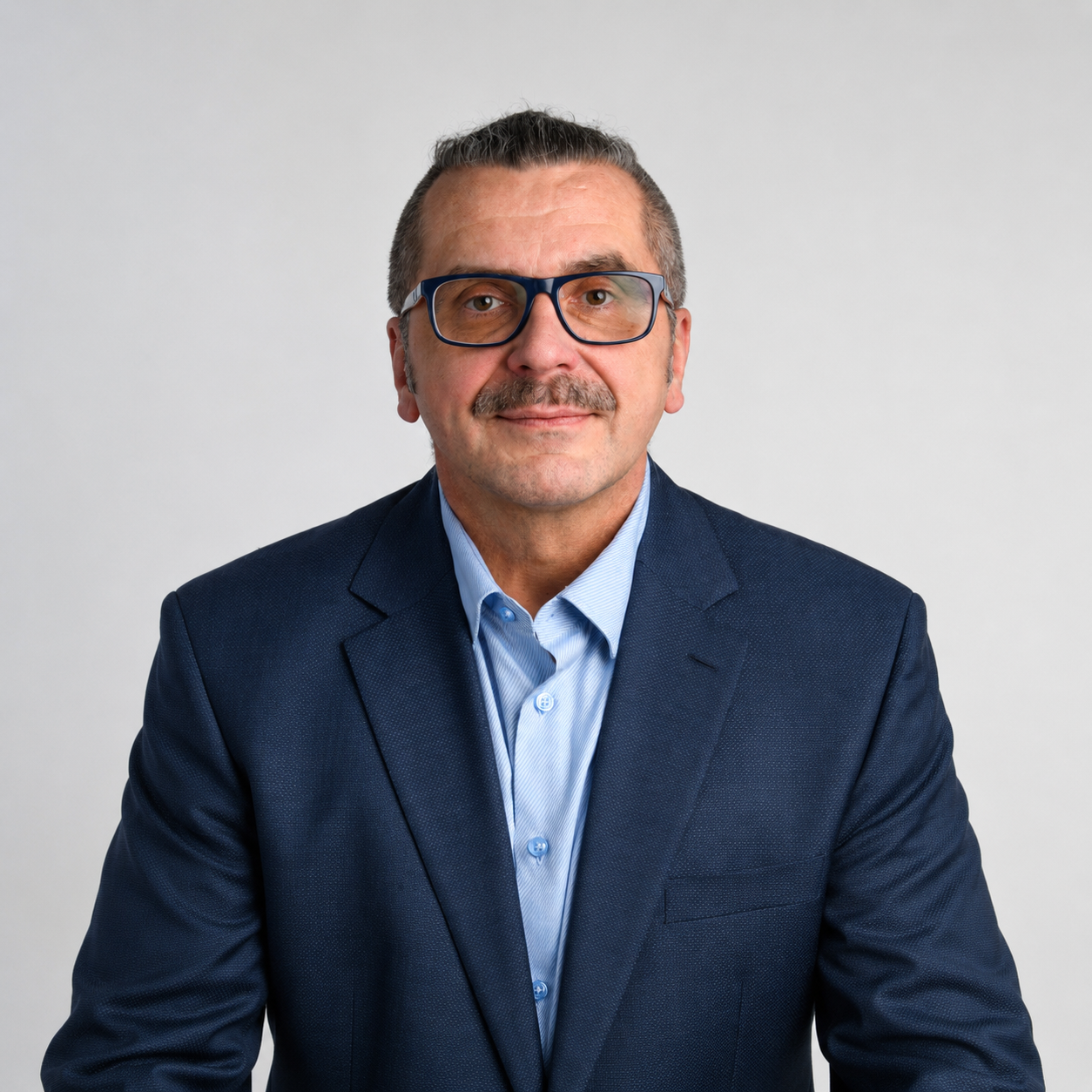
Professor Jacek Sroka, PhD, DSc
Chief Research Specialist in the Security and Defense Innovation Center
Biography
A graduate of the University of Wrocław, political scientist, full professor (title conferred by the President of the Republic of Poland in October 2010). He specializes in public policy, public administration, deliberation, participation, and co-decision-making. A student of Prof. Ryszard Herbut. Recipient of scholarships from the NATO Fellowship, Jean Monnet, and TEMPUS programs (during his doctoral studies at the University of Vienna, under the academic supervision of Prof. Georg Winckler). As a project manager and researcher, he has participated in 24 national and international research projects. He is a long-standing expert for the European Foundation for the Improvement of Living and Working Conditions, based in Dublin, and a regular contributor to The Andrzej Bączkowski “Dialog” Center for Social Partnership in Warsaw.
Author of domestic and international scientific, research, and analytical studies, including: 5 monographs authored alone, 12 co-authored monographs, 3 edited monographs, 7 co-edited monographs, 160 articles and chapters, as well as approximately 70 expert reports and 30 popular science articles. He has completed a number of research fellowships, including in Ankara, Berlin, Bratislava, Brussels, Brno, Donetsk, Dresden, Galway, Geneva, Lecce, Lisbon, Ljubljana, Málaga, Madrid, Milan, Paris, Vienna, Vilnius, and Wuppertal. He has collaborated with domestic and foreign government and local government agencies, domestic and foreign research institutes, as well as with NGOs, labor unions, and employers’ organizations. Recipient of university awards and one ministerial award. He has held and continues to hold academic positions by election and appointment. Reviewer in numerous doctoral, habilitation, and professorial proceedings, including those abroad. He has supervised eight doctoral candidates and approximately three hundred master’s and bachelor’s degree candidates. He is currently supervising four English-speaking doctoral candidates at the Doctoral School of the University of the National Education Commission in Kraków.
- ORCID: https://orcid.org/0000-0002-4432-3720
- Google Scholar: https://scholar.google.com/citations?user=hEl6cokAAAAJ&hl=pl
- ResearchGate: https://www.researchgate.net/profile/Jacek-Sroka-3
Research areas: public policy; public administration; social and civic dialogue; participatory deliberation; co-decision-making; industrial relations; political, electoral, and party systems; regional and local development.
Publications:
- Co-determination in public policy, J. Sroka, “Parliamentary Review” 2019, 4(153), pp. 71-86.
- The Breakdown of Industrial Relations in Europe as a Prelude to the Economy 4.0, “Przegląd europejski” 2019, p. 9-29
- Participatory Budgeting in Hrubieszów, Poland, as an Example of Residents’ Sustainable Participation in Shaping Public Expenditure, co-authored with J. Sroka, B. Pawlica, W. Ufel, “Studies in Public Policy” 2023, 1(10), pp. 41-56.
- Deliberative Empowered Democracy—The Systemic Position of the Actor and the Components of Public Decision-Making. An Attempt to Expand and Reinterpret Luigi Bobbio’s Model Proposal , “Teoria Polityki” 7(1), pp. 121–146.
- Is Arend Lijphart’s Model Still Valid? Political Parties, Interest Groups, Pluralism, and Corporatism , J. Sroka, “Political Theory” 2024, no. 10, pp. 177-206.
- Being For, or Even Against: Logical Culture, Types of Argumentation Modes in Political Discourses, and the Leading Role of Everyday Pragmatism, J. Sroka, “Teoria Polityki” 2024, no. 10, p. 211-232.
- Too Many or Too Few Options? The Causes of a Lack of Synergy in the Knowledge Regime and Perspectives on Modeling Change Using Contemporary Public Behavioralism Methods , “Studies in Public Policy” 2025 12(3), p. 51-76.
- Corporatism and Pluralism as Fuzzy Sets and the Place of the Polish—Unstable—Version of Social Dialogue in the Categorization of European Industrial Relations, (in:) “Social Dialogue—Ruts and Crossroads,” I. Zakrzewska, J. Gardawski (eds.), Warsaw: CPS Dialog, p. 203-237.
- A Deliberative Tortoise or a Referendum Hare? The Evolution of Participatory Budgeting in Poland and Its Future Prospects , “Studia Politologiczne,” vol. 80(2/2026), pp. 104–127.
Other publications by the author
Selected monographs:
- Networks or Structures? Social Dialogue at the Regional Level , eds. M. Błaszczyk, J. Sroka, Warsaw: Institute of Public Affairs, 2006.
- Deliberation and Multiband Governance, J. Sroka, Wrocław: Wydawnictwo Uniwersytetu Wrocławskiego 2009.
- Co-Decision-Making in Multidimensional Public Policy, J. Sroka, Warsaw: ELIPSA Publishing House, 2018.
- Planning and Evaluation of Public Policies, co-authored by J. Sroka, J. Podgórska-Rykała, C.H. Beck, Warsaw 2021.
- Evolution of the civic budget in Poland – towards deliberation or plebiscite?, co-authored by J. Sroka, B. Pawlica, W. Ufel, Kraków: Libron Publishing House 2022.
- The Evolution of Participatory Budgeting in Poland—Toward Deliberation or a Plebiscite?, co-authors: J. Sroka, B. Pawlica, W. Ufel, Kraków: Libron Publishing House 2022.
- Appearance and Abstraction: In Search of the Sources of Powerlessness in Public Decision-Making , co-authors: J. Sroka, B. Pawlica, W. Ufel, Kraków: Libron Publishing House, 2023.
- Spheres of Power (and Powerlessness) in Public Discourse and Co-Decision-Making, co-authors: J. Sroka, B. Pawlica, W. Ufel, Kraków: Libron Publishing House 2024.
- Participatory Deliberation—Progress, Regression, or Stagnation?, co-authors: J. Sroka, W. Zając, B. Pawlica, Kraków: Libron Publishing House, 2025.
Selected research projects:
- The Role of Trade Unions in the Process of Establishing a System for the Representation of Political Interests in Poland. NATO Fellowship Program , role in the project: contractor, year of completion: 1995.
- Development of social dialogue at the regional level; role in the project: project manager; project years: 2004–2006.
- Institutions of Participatory Democracy in the Polish Political System (N117 023 31/0985), role in the project: principal investigator, project period: 2006–2008.
- Systemic project OPKL 5.5.1, Improving the functioning of the social dialogue system and strengthening the participants and institutions of social dialogue, function in the project: member of the research team, contractor of the research module dedicated to institutionalized social dialogue at the regional level, implementation period: 2008-2009.
- Analysis of Social Risks in Lower Silesia. Use of social survey results in various areas of life to forecast social risks in the region (POKL.08.01.04-02-003/08), role in the project: co-contractor, year of implementation: 2010.
- National expert on two multi-year projects of the European Foundation for the Improvement of Living and Working Conditions, based in Dublin (https://www.eurofound.europa.eu/en/home): European Industrial Relations Observatory; European Working Conditions Observatory; role in the projects: national expert; project duration: 2004–2010.
- The Evolution of Participatory Budgeting in Poland—Toward Deliberation or a Plebiscite? (NCN OPUS17, 2019/33/B/HS5/00353), role in the project: principal investigator, project duration: 2020–2025.
- Commissioned research project (MNiSW/2025/DIR/174) “Evaluation of Links Between Science and Business.” Role in the project: Principal Investigator for Phase II of the research: “Demonstrating the impact of science policy on socioeconomic changes: effective verification of the third evaluation criterion.” Results are currently confidential: the Ministry of Science and Higher Education has five project implementation reports in its possession.
- GOSPOSTRATEG-XII/0001/2025, titled “Frameworks and Directions for Implementing theSmart Village Concept in National and Regional Development Policies,” role in the project: research team member, project implementation began in 2026.