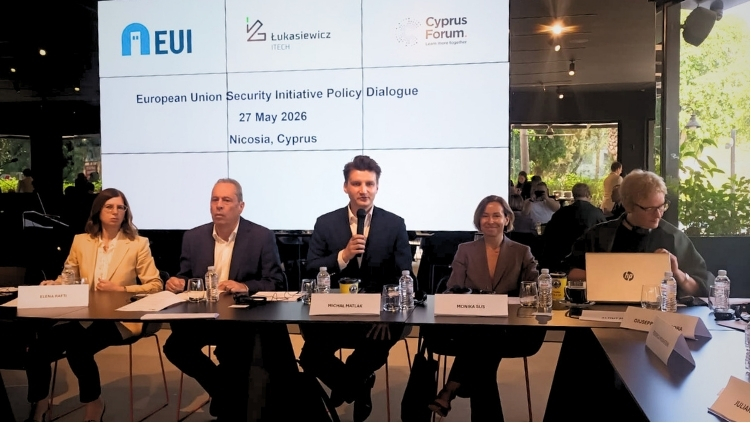
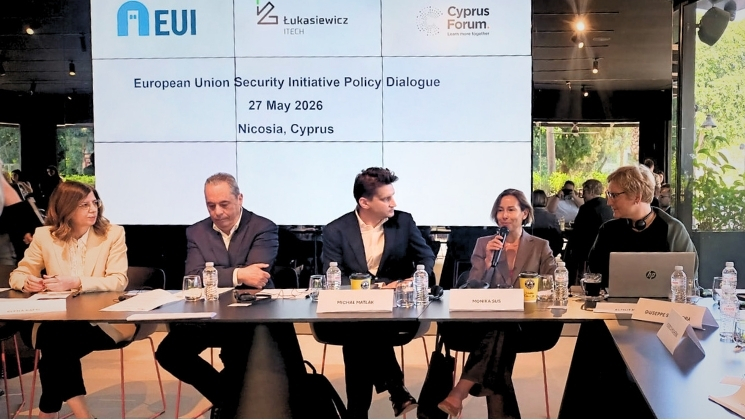
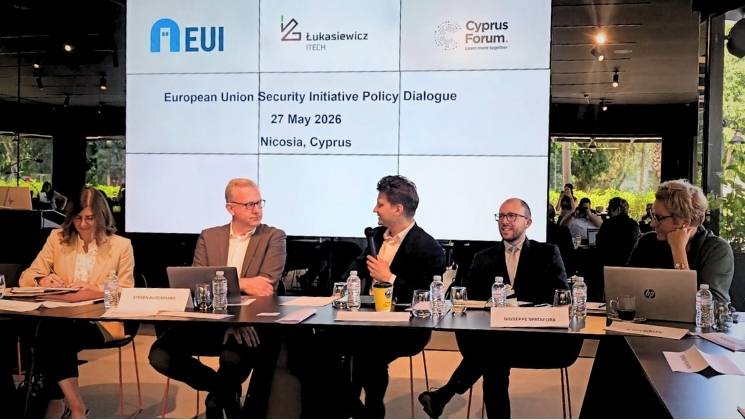
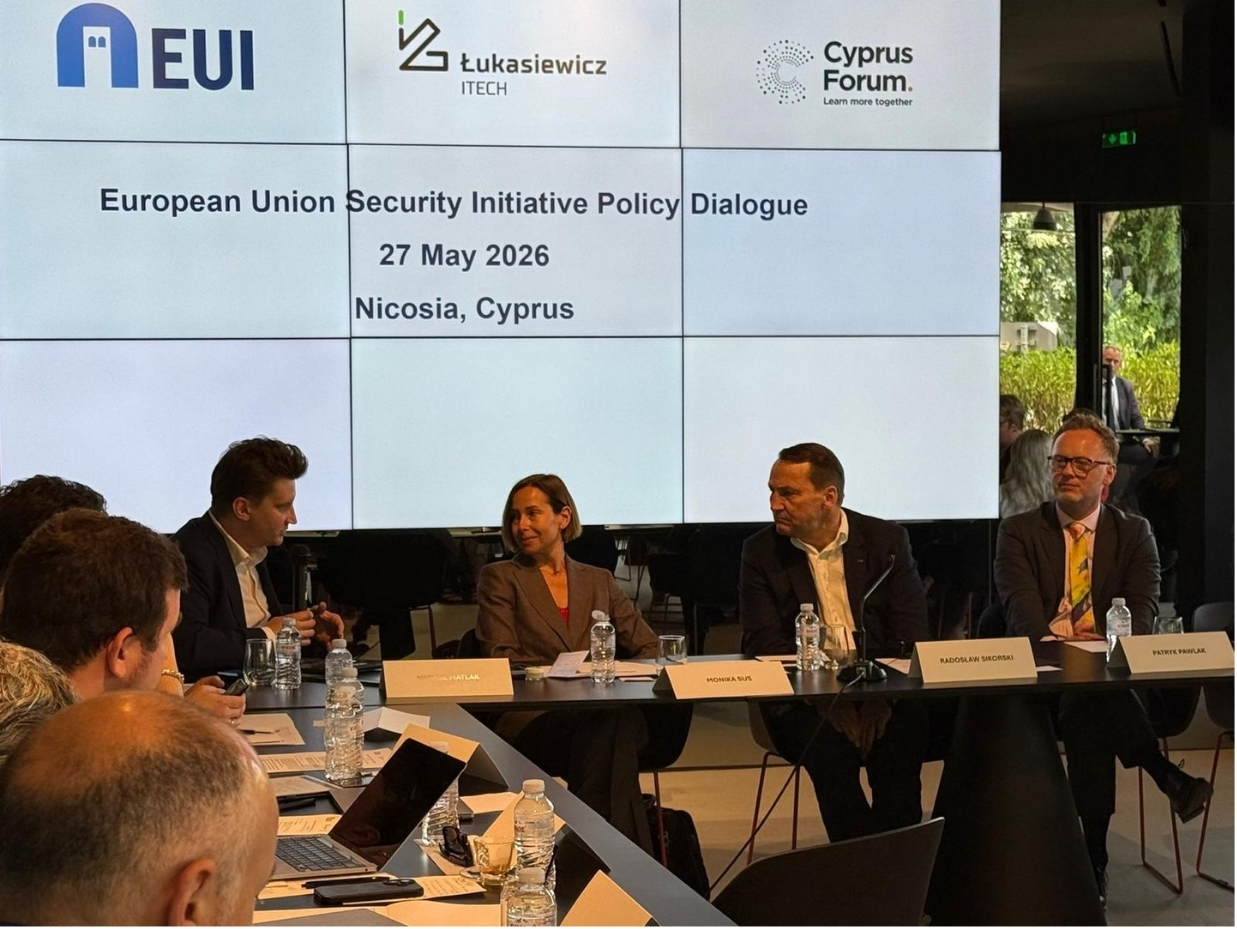
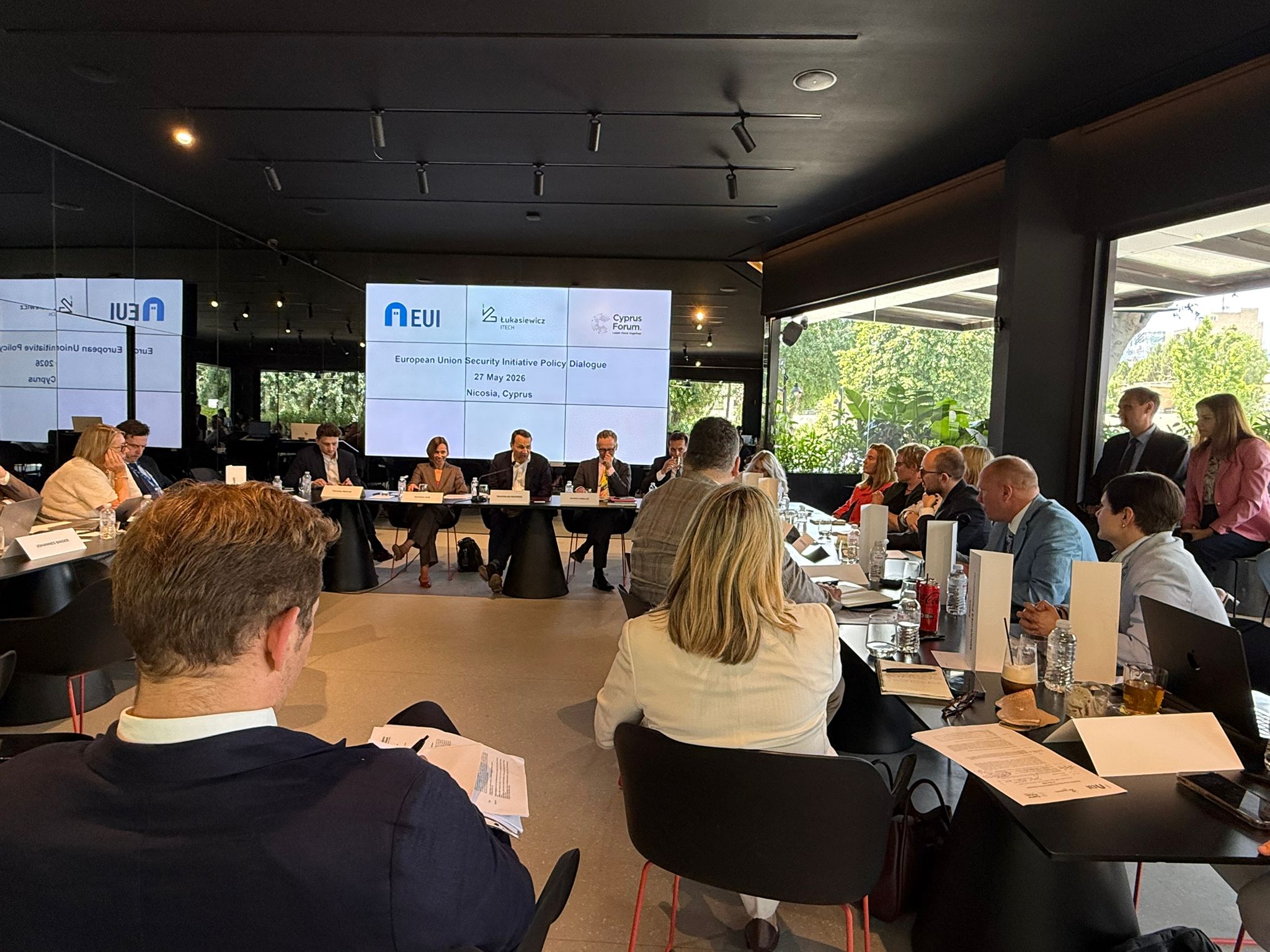
The European Union Security Initiative (EUSI) Policy Dialogue is a series of conferences in which Łukasiewicz – ITECH and the European University Institute in Florence, together with local partners, organize debates in the capitals of countries holding the EU Council presidency among experts and policymakers on the challenges facing the European security architecture.
The latest edition of the EUSI Policy Dialogue was held in Nicosia, parallel to the informal meeting of EU foreign ministers (the so-called Gymnich format), in cooperation with local partner Cyprus Forum.
The session was opened by Republic of Cyprus Defense Minister Vasilis Palmas, prof. Monika Sus and Lukasiewicz – ITECH Director Dr. Michal Matlak, who also moderated the first panel on the new European Security Strategy prepared by the European Union. W panelu udział wzięli m.in. Steven Blockmans, Almut Möller, Giuseppe Spatafora oraz Elena Rafti, dyskutując o redefinicji europejskiej strategii bezpieczeństwa w kontekście raportu byłego prezydenta Finlandii Sauliego Niinistö, dotyczącego trzech dróg wzmocnienia europejskiego bezpieczeństwa.
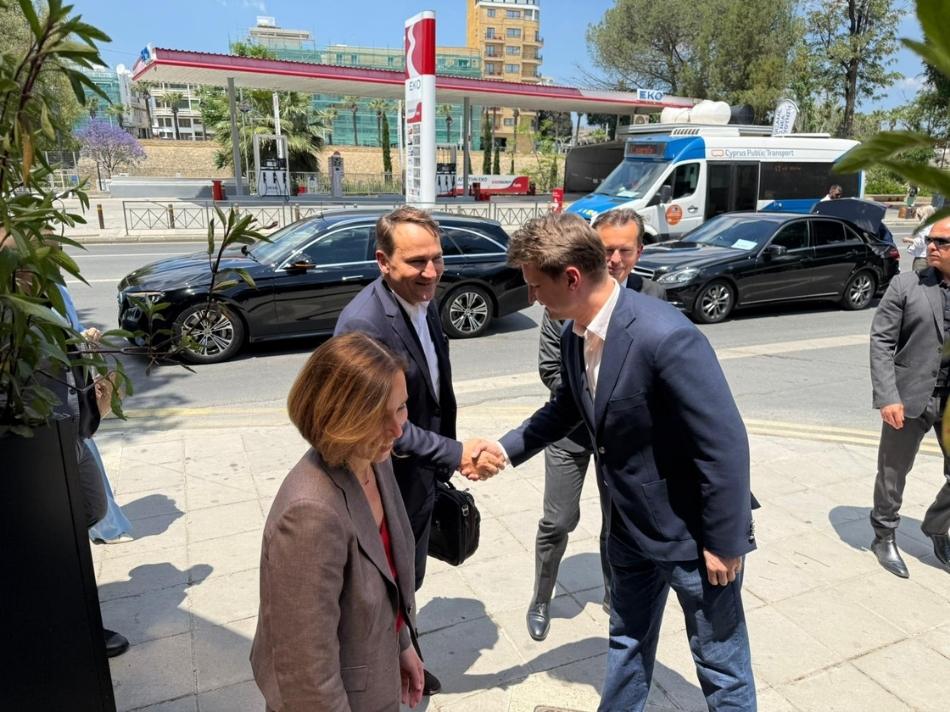
Today’s Policy Dialogue was designed as a full-day, in-depth conversation about how Europe should update its security strategy – from new decision-making formats, to resilience against hybrid threats, to economic-military pressures. In the following panels, participants discussed security in the face of war and hybrid attacks (panel 2), political intuitions and disagreements at the highest level (panel 3 – a high-level fireside chat with Vice President of the Council of Ministers, Minister of Foreign Affairs of Poland Radoslaw Sikorski), as well as building a European defense-industrial base and implementing the SAFE initiative (panel 4).
A special place on the program was given to a conversation with Deputy Prime Minister and Minister of Foreign Affairs of Poland Radoslaw Sikorski, moderated by Prof. Monika Sus and Patrick Pawlak. The discussion touched on key security dilemmas: long-term support for Ukraine, the future of transatlantic ties and the role of NATO in the European security architecture, as well as tensions in the Middle East and the challenges posed by Iran. The conversation ranged from strategic assumptions to specific questions about military capabilities, the defense-industrial base, and the institutions that determine the Union’s real agility.
As Minister Radosław Sikorski put it in his communication after the EUSI Dialogue meeting:
“Let’s keep calm. The United States and Europe need each other. For mutual benefit, they should cooperate wherever possible. (…) It is not necessary to agree on everything in order to trust each other on the most important issues.”
The Policy Dialogue in Nicosia brought together representatives of governments, European Union institutions, think tanks and academia from across Europe – from experts from the European Union Institute for Security Studies, to analysts from Polityka Insight, the Polish Institute of International Affairs (PISM), the Institut de recherche stratégique de l’École militaire, the Kiel Institute for the World Economy, the Center for European Policy Studies, the European Policy Centre, the Hellenic Foundation for European and Foreign Policy or Carnegie Europe. The format, based on the work of a permanent group of EUSI experts, allows new ideas to be tested, national perspectives to be confronted, and solutions to be developed that realistically strengthen the European Union’s ability to operate in an increasingly demanding security environment.
The Nicosia meeting builds on the path set by earlier dialogues in Brussels and Copenhagen and represents another step in building a sustainable, knowledge-based European ecosystem for the security debate.
We encourage you to read the PAP (Polish Press Agency) dispatch on the event and view the photo gallery below.