/ PUBLICATIONS
the Analysis and Technology Development Center
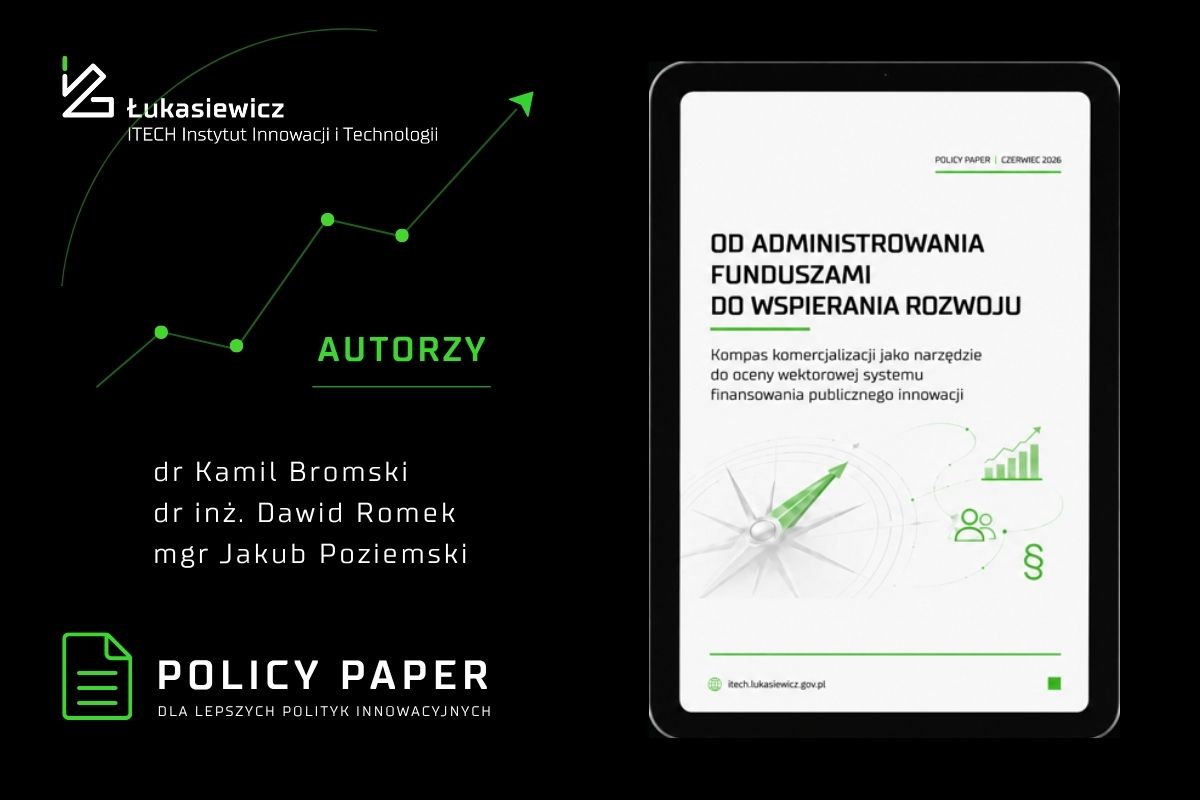
Policy paper: “From Administering Funds to Driving Growth: The Commercialisation Compass as a Multidimensional Framework for Assessing Public Innovation Funding”
How can we determine whether public funding for innovation genuinely supports business growth, the commercialisation of new technologies and the development of a more competitive economy? This question is becoming increasingly important amid intensifying technological competition, accelerating digital transformation and the reshaping of industrial policy across the European Union.
Łukasiewicz – ITECH has published a new policy paperFrom Administering Funds to Driving Growth: The Commercialisation Compass as a Multidimensional Framework for Assessing Public Innovation Funding. ”.
The publication was authored by Kamil Bromski, PhD, Deputy Head of the Analysis and Technology Development Center Dawid Romek, PhD Sc. Eng. and mgr Jakub Poziemski.
The paper introduces the Commercialisation Compass, a new framework for evaluating innovation policy. Its purpose is to support a more integrated, data-driven assessment of how effectively public funding translates into innovation outcomes.
From Fund Absorption to Measuring Real-World Impact
Innovation policy can no longer be assessed solely in terms of how much funding has been spent, how many projects have been completed or whether formal programme targets have been met. What matters increasingly is whether public support genuinely strengthens companies’ technological capabilities, enables the successful commercialisation of R&D outcomes and delivers lasting economic benefits.
The authors argue that traditional evaluation models tend to focus on output and outcome indicators, such as the number of funded projects, the value of support awarded, patents filed or solutions brought to market. While these figures help illustrate the scale of public intervention, they do not always show whether the observed changes were actually driven by public funding or whether their effects are sustained over time.
The Commercialisation Compass: a Modern Approach to Evaluation
The proposed Commercialisation Compass is designed to shift the focus from assessing regulatory compliance and fund absorption towards measuring the actual impact of innovation policy on business and technological development.
The framework provides a multidimensional view of the outcomes generated by public funding. Alongside economic performance, it considers technological progress, patent activity, commercialisation capacity, organisational resilience and wider systemic impact.
This approach could support comparisons across funding programmes, calls for proposals and beneficiary groups, while also helping to identify projects with particularly strong technological and market potential.
Evidence-Based Public Policy
The publication reflects a broader European shift from traditional fund administration towards evidence-based governance. This means moving beyond the monitoring of expenditure and strengthening the public sector’s capacity to learn, adapt and design more effective instruments for technological development.
From this perspective, evaluation is no longer simply a tool for control and accountability. It becomes an integral part of the strategic management of innovation policy.
The paper’s conclusions are clear: effective management of public innovation funding requires tools that assess not only how much has been spent, but above all what lasting economic, technological and systemic outcomes have been achieved as a result.
The publication was developed as part of the publicly funded research project “The Effectiveness of Financial Support Mechanisms for the Commercialisation of New Technologies in Poland.”
The full policy paper is available below.