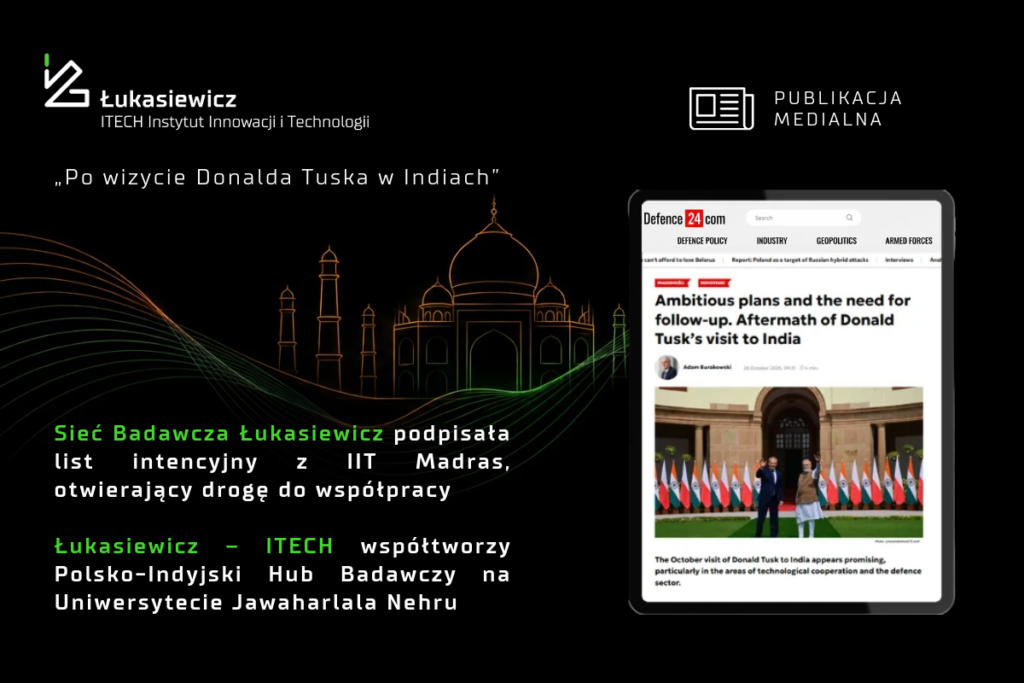
The signing of a letter of intent between the Łukasiewicz Research Network and India’s IIT Madras, as well as the establishment of a Polish-Indian research hub at Jawaharlal Nehru University with the involvement of Łukasiewicz – ITECH, are among the outcomes of Prime Minister Donald Tusk’s October visit to India. Writing for Defence24.com, Adam Burakowski, PhD, Professor at the Institute of Political Studies of the Polish Academy of Sciences, former Polish Ambassador to India and Non-Resident Fellow of the Łukasiewicz – ITECH Asia Programme, examines the significance of these initiatives and the prospects for further economic, technological and defence cooperation.
In his article “Ambitious Plans and the Need for Follow-Up. Aftermath of Donald Tusk’s Visit to India”, Adam Burakowski examines the outcomes of the first visit to India by a Polish prime minister in 16 years. As he points out, the high-level meetings opened up new opportunities for developing bilateral relations, particularly in advanced technologies, the defence industry and economic cooperation. Both countries declared their ambition to double bilateral trade to USD 12 billion by 2030.
Cooperation in cybersecurity, defence innovation, critical technologies and the space sector was a key focus of the discussions. The author also highlights the growing importance of ties between businesses, academic institutions and research and development centres, which could help translate political commitments into concrete initiatives.
Initiatives involving the Łukasiewicz Research Network and Łukasiewicz – ITECH feature prominently among the outcomes of the visit. The Łukasiewicz Research Network signed a letter of intent with the Indian Institute of Technology Madras (IIT Madras), one of India’s leading scientific and technological institutions, and held discussions with other research and development organisations. Meanwhile, a Polish-Indian hub was established at Jawaharlal Nehru University in New Delhi through cooperation with the Faculty of Political Science and International Studies at the University of Warsaw and Łukasiewicz – ITECH.
These initiatives form part of the Łukasiewicz – ITECH Asia Programme, which aims to strengthen cooperation with scientific, technological and institutional partners across Asia, including India. The programme focuses on identifying strategic areas for cooperation and fostering long-term relationships between Polish and Asian research and business communities.
Adam Burakowski emphasises that the key challenge is to ensure continuity in the initiatives already launched. In his view, only the consistent implementation of the agreements reached, supported by the active involvement of government institutions, will make it possible to realise the potential of the Polish-Indian partnership and translate ambitious plans into long-term results.