Member States Defend, the EU Coordinates and Supports
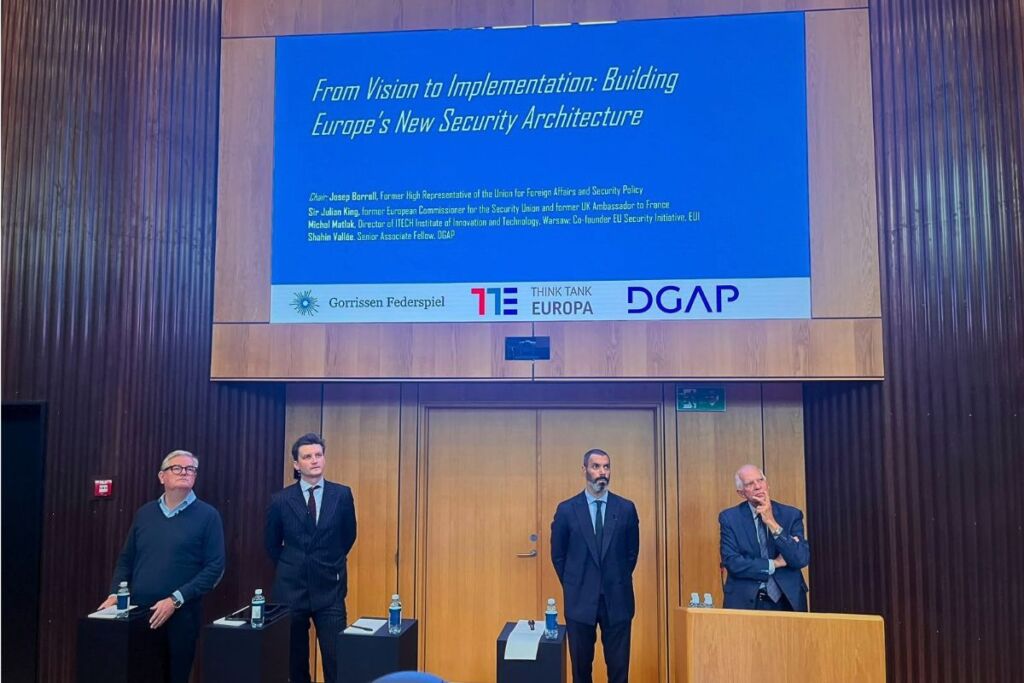
This was the main takeaway from the speech Michal Matlak, PhD , Director of Łukasiewicz – ITECH, during the panel “From Vision to Implementation: Building Europe’s New Security Architecture”, which opened the closed-door European Security & Defense Architecture conference in Copenhagen, organised by Gorrissen Federspiel, Think Tank EUROPA and DGAP.
The discussion was moderated by Josep Borrell, former High Representative of the European Union for Foreign Affairs and Security Policy. The panel also featured Sir Julian King, former EU Commissioner for the Security Union and former British Ambassador to France, and Shahin Vallée of the German Council on Foreign Relations (DGAP).
The main points of Michał Matlak’s intervention:
- The EU is a force multiplier for its Member States – and this should also define the framework for its role in defence.
- A clear division of roles and responsibilities is essential. Defence remains the responsibility of the Member States, while EU institutions should do everything they can to support them in fulfilling that role. Blurring these responsibilities is dangerous.
- The EU’s role: space, defence industrial cooperation, support forces, and strategic enablers.
- The role of the Member States: responsibility for their own capabilities and for maintaining effective alliances.
- Invoking Article 5 requires consensus, but everything else ultimately depends on the Member States. In practice, this will mean a coalition of the willing – and we need to work to ensure that, in a moment of crisis, that coalition is as broad as possible.
- The EU’s response to the war in Ukraine has proved far stronger than many had expected. The latest example is SAFE: an instrument that is far from perfect, but one that is also likely to transform other sectors of industry. This is a conclusion drawn from discussions with leaders of Polish industry.
- A European Security Council? New institutions will not solve our problems, although a forum for discussion bringing together EU Member States, Ukraine, the United Kingdom, Canada and Norway would of course be welcome.
We would like to thank the organisers for the invitation and the opportunity to take part in the discussion.