/ PUBLICATIONS
From Hormuz to Europe: A New Policy Paper on EU Energy Resilience
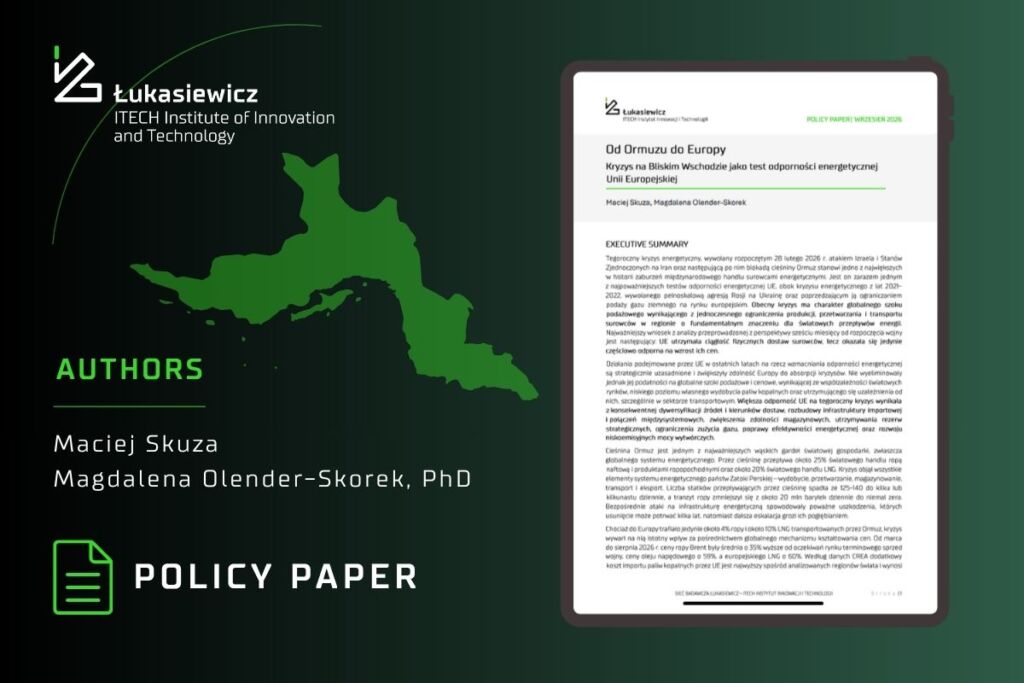
How can a crisis unfolding thousands of kilometres from Europe affect energy prices, economic activity and the European Union’s energy security? A new Łukasiewicz – ITECH policy paper, From Hormuz to Europe: The Middle East Crisis as a Test of EU Energy Resilience, authored by Maciej Skuza of the Centre for Energy Transition Research and Magdalena Olender-Skorek, PhD, Chief Specialist for Economic Analysis in the Department of Strategy and Analysis, examines the impact of this year’s crisis in the Middle East and the blockade of the Strait of Hormuz on Europe’s energy system. Chief Specialist for Economic Analysis in the Department of Strategy and Analysis, examines the impact of this year’s crisis in the Middle East and the blockade of the Strait of Hormuz on Europe’s energy system.
The escalation of the conflict between Israel and the United States on the one hand and Iran on the other, which began on 28 February 2026, followed by disruptions to shipping through the Strait of Hormuz, led to one of the most severe disruptions to international trade in energy commodities on record. For the European Union, this became another major test of its resilience to a sudden contraction in global energy supply, following the energy crisis of 2021–2022.
Why Does the Strait of Hormuz Matter to Europe?
The Strait of Hormuz is one of the world’s most critical chokepoints for global energy flows. Before the crisis, approximately 25% of global trade in crude oil and petroleum products, as well as nearly 20% of global LNG trade. At the same time, the scope for redirecting exports from Gulf states via alternative routes remains limited.
Interestingly, Europe is not the main destination for energy commodities shipped through the Strait of Hormuz. In 2025, only 4% of Europe’s crude oil imports and around 10% of its LNG imports passed through the strait. This did not, however, shield the EU from the consequences of the crisis. Global fossil fuel markets are highly interconnected, meaning that a supply disruption in one of the world’s key producing regions can drive up prices even in markets with relatively limited direct import exposure.
The EU Maintained Energy Supplies but Could Not Avoid Price Increases
One of the paper’s key conclusions is the distinction between the physical availability of energy and its affordability.
Measures taken by the European Union in the wake of the 2021–2022 energy crisis—including the diversification of energy sources and supply routes, the expansion of LNG infrastructure and cross-border interconnections, greater storage capacity, the maintenance of strategic reserves, reduced gas consumption, and the development of low-carbon energy sources—have strengthened the European energy system’s ability to absorb further shocks.
As a result, the EU avoided severe physical shortages of energy commodities. At the same time, these measures were unable to insulate the European economy from rising global prices. The authors therefore argue that The EU passed the test of maintaining continuity of supply, but only partially passed the test of affordability.
Key Findings and Recommendations
- Low Dependence Does Not Mean Low Vulnerability. The EU remains exposed to global supply and price shocks, even when its direct imports from the Persian Gulf are limited.
- Diversification must extend beyond suppliers to include transport routes and supply chains. The security of critical chokepoints such as the Strait of Hormuz, the Bab el-Mandeb Strait and the Suez Canal is therefore of paramount importance.
- Strategic reserves strengthen short-term resilience, but they are finite and do not address the structural sources of vulnerability.
- In the long term, reducing dependence on fossil fuels will be crucial. This will require the further development of renewable and nuclear energy, electrification, greater energy efficiency and the deployment of new technologies.
- The energy transition is an integral part of the EU’s security framework, while its resilience is further strengthened by joint crisis-response mechanisms and energy solidarity.
The Energy Transition as an Investment in Resilience
The analysis shows that Europe’s energy system is now better equipped to withstand external shocks than it was during the 2021–2022 energy crisis. Supply diversification, infrastructure expansion and longer-term structural changes have helped reduce the risk of shortages and made the European economy less vulnerable to supply disruptions. This does not, however, amount to full resilience—particularly if the conflict becomes protracted or escalates further.
The authors therefore emphasise the need to move beyond a reactive approach to energy security and towards building long-term, comprehensive resilience.. This should not be limited to replacing one fossil fuel supplier with another. The key is to gradually reduce the European economy’s exposure to fuels whose prices and availability are shaped by geopolitical instability, the security of global transport routes and developments in energy-exporting regions.