
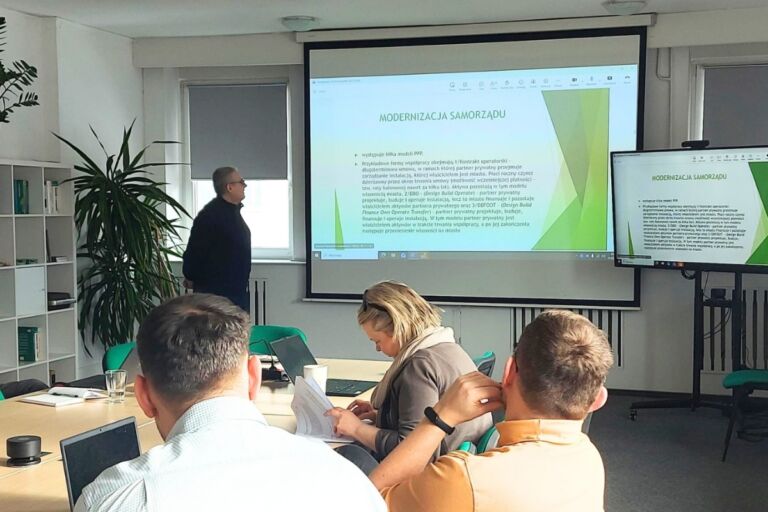
During the seminar conducted by prof. Ph. Jack Wojnicki Participants had the opportunity to look at the public-private partnership (PPP) mechanism as a tool for public investment.
The meeting focused on the practical aspects of PPP implementation and its role in the current system of financing public projects.
PPP is a model of cooperation between the public and private sectors, used primarily where local governments’ own revenues (about 50% of budgets) do not allow them to carry out large investments on their own.
At the same time, in the context of the changing structure of public investment financing in Europe, the role of this mechanism is gradually increasing.
In Poland, 203 PPP contracts worth more than PLN 10 billion were signed between 2009 and 2024.
The projects are carried out mainly in the more developed regions, including Mazovia, Silesia and Greater Poland, and include mainly transportation infrastructure, urban revitalization and investments in sports and tourism. Examples include underground parking lots in Warsaw and Wroclaw, the modernization of bus stops in Cracow, revitalizations in Gdansk and Sopot, and the construction of a hospital in Zywiec.
As Prof. Wojnicki stressed, PPP can become an important tool for financing local investments.
As pointed out during the meeting, PPP can bring tangible benefits – relieving the burden on public budgets, more efficient implementation of investments and use of private sector know-how. At the same time, the development of this model in Poland still faces barriers, such as distrust of cooperation with business, complexity of procedures or limited experience of public administration.
The conclusions are clear: public-private partnerships are an important complement to the available sources of investment financing and can play an increasingly important role in the development of public projects – provided that competencies and cooperation between sectors are further strengthened.