
On Thursday, January 8, our Institute hosted a meeting devoted to the future of Horizon Europe 2.0 – a key European Union instrument for funding research and innovation in the 2028-2034 perspective. The meeting had an expert character and was an opportunity to exchange views on the future shape of Horizon Europe and the conditions for increasing Poland’s participation in European research and innovation programs. The conclusions of the discussion are an important voice in the debate on the effective use of EU funds for research and innovation.
Our guest was Dr. Marcin Wronski, newly appointed member of the Fiscal Council and former chief economist of the Lukasiewicz Center, who presented an analysis titled “The Fiscal Council. “Horizon Europe 2.0. Analysis and Recommendations,” prepared as an expert contribution to the negotiation of the new perspective of the EU framework program.
According to current assumptions, the budget of Horizon Europe 2.0 is to be significantly increased – even by more than 80% compared to the current perspective. The program will be one of the main tools for supporting research, technological development and innovation, as well as strengthening the competitiveness of the European Union.
Poland’s position – diagnosis
The data presented shows that:
- Poland is currently raising about 1.54% of Horizon Europe funding;
- In relation to our share of EU GDP, we are at the bottom of the ranking of beneficiaries;
- Of one euro paid by Poland into the program’s budget, only 63 cents return to the country.
This indicates that there is significant innovation potential that is not being fully exploited under the current program mechanisms.
Recommendations discussed at the meeting
In the presentation and discussion, Dr. Vronsky identified and elaborated on several directions relevant to Poland in the context of science and innovation funding from the program:
- Keeping Horizon Europe’s budget as large as possible;
- Protecting and strengthening Widening mechanisms to level the playing field for countries with lower levels of participation in the program;
- Active involvement in the work on the European Competitiveness Fund, including simplification and unification of application rules;
- Submission of research and innovation topics relevant to Poland’s perspective, including in the areas of defense and dual-use technologies, energy transition, digitization and health care.
The voice of practitioners – a business perspective
An important addition to the presentation was a discussion with a representative of the private sector. Adam Dawidziuk (7bulls.com) also joined the conversation, drawing attention to the effects of current systemic solutions on technology companies, particularly in the context of regulatory barriers, administrative costs and processes for commercialization of research and R&D results.
Adam Dawidziuk stressed that without a better match between public instruments and the realities of technology companies, research potential will not be effectively translated into market implementations.
The new Horizon Europe 2.0 perspective is not only more funding, but also a negotiating window in which it is possible to realistically strengthen Poland’s position in the European innovation system. Of key importance will be the activity of public institutions, the scientific community and the innovation sector – both at the stage of shaping the program and its subsequent implementation.
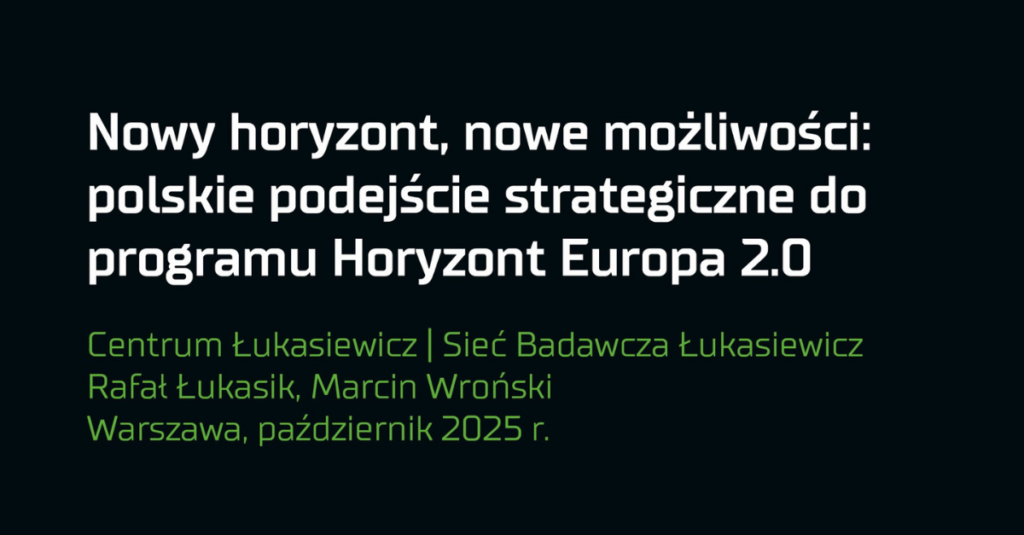
We encourage you to read the report “New horizon, new opportunities: the Polish strategic approach to Horizon Europe 2.0”, authored by prof. Dr. Eng. Rafal Lukasik and Dr. Marcin Wronski.