Is increased investment in research and development enough to make Poland’s economy more innovative? Or is the real issue not only how much is spent, but whether public funding genuinely leads to implementation, commercialisation and productivity growth?
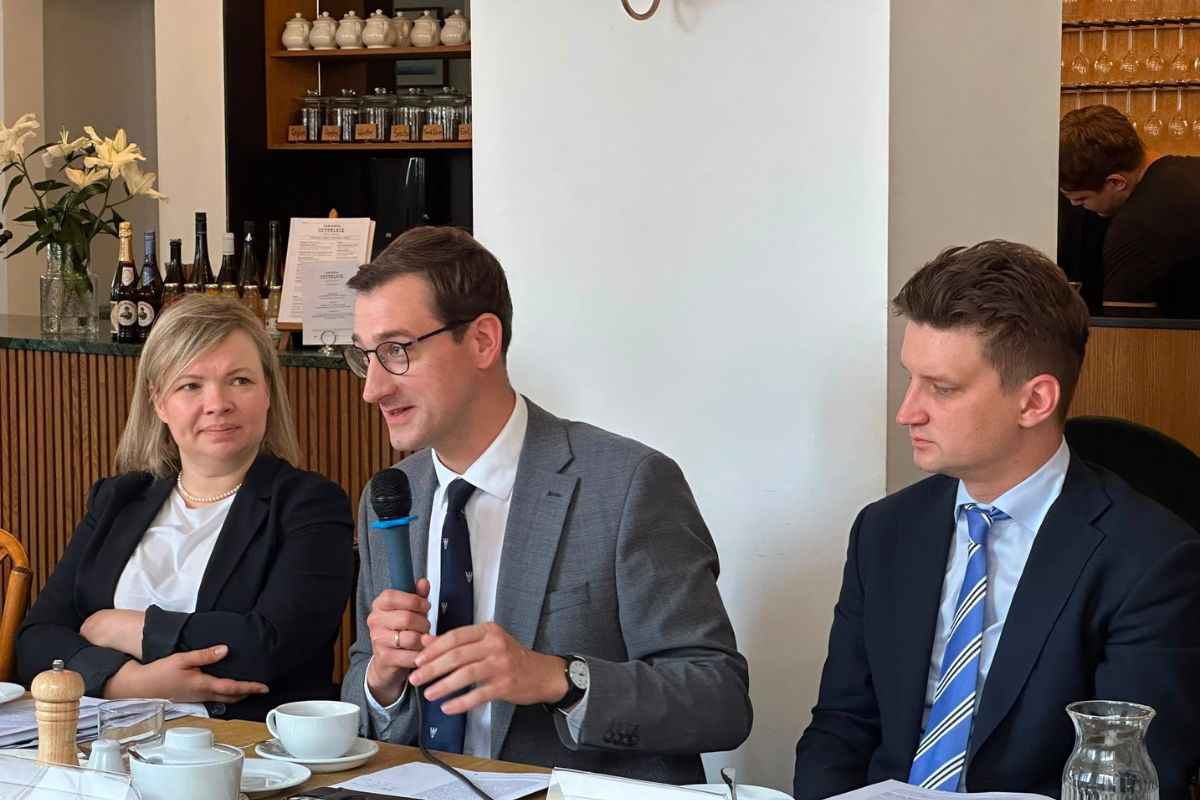
These questions were at the heart of the expert breakfast, How Can We Strengthen Poland’s Innovation Ecosystem?, held on 30 June 2026 at Café Czytelnik in Warsaw. Organised by Łukasiewicz – ITECH in partnership with the Łukasiewicz Centre, the event brought together experts in innovation policy, economics and R&D funding, alongside representatives from the media, think tanks and the business community.
The discussion was framed around two publications exploring how Poland’s innovation system can be strengthened and how public funding for research and development can be used more effectively. The first was a monograph published by the Łukasiewicz Centre, R&D-Led Growth: How Can We Accelerate Poland’s Economic Development? The second was a policy paper by Łukasiewicz – ITECH, From Administering Funds to Driving Growth: The Commercialisation Compass as a Multidimensional Framework for Assessing Public Innovation Funding. ”.
Innovation as a Driver of Competitiveness
The meeting was opened by Michał Matlak, PhD, Director of Łukasiewicz – ITECH, who stressed that the debate on innovation cannot be reduced to funding levels alone. The key question is whether government, public institutions and the economy are able to turn knowledge into technological progress, successful implementation and productivity growth.
Opening remarks were also delivered by Hubert Cichocki, PhD, Head of the Łukasiewicz Centre. He highlighted the role of the Łukasiewicz Research Network as one of the key players in Poland’s innovation system, bringing together research capacity, technological expertise and close cooperation with business. Seen in this context, strengthening the innovation ecosystem matters not only to research institutes, but to the economy as a whole.
Spending 3% of GDP on R&D Is Not an End in Itself
The first presentation was delivered by Janusz Jabłonowski, PhD, Chief Economist of the Łukasiewicz Research Network, and Wiktor Wojciechowski, PhD, co-authors of the Łukasiewicz Centre monograph R&D-Led Growth: How Can We Accelerate Poland’s Economic Development?
They explored possible pathways towards stronger, R&D-driven economic growth. One of their central arguments was that Poland is gradually reaching the limits of its existing development model, which has relied on expanding labour supply, lower labour costs and the adoption of technologies developed elsewhere. Further economic convergence will require growth to be driven more strongly by investment, intangible assets, innovation and R&D spending-particularly in industry, where expenditure currently stands at just 34% of the EU average.
Although public R&D expenditure in Poland has increased over the past decade from approximately EUR 43 to EUR 113 per capita, it remains less than half the EU average. Higher spending alone, however, does not automatically translate into greater innovation. The effectiveness of the system ultimately depends on its ability to turn investment into knowledge, intellectual property, market-ready solutions, sales and sustained productivity growth.
A particularly important part of the presentation was an in-depth econometric analysis showing that the impact of R&D investment on GDP growth may take between eight and fifteen years to emerge. This means that innovation policy cannot rely on short-term or one-off interventions.
The authors examined three possible scenarios for future R&D spending: maintaining the status quo, reducing expenditure to 1% of GDP, and increasing it to 3% of GDP. They argued that embarking on a sustained path of higher investment could generate cumulative GDP gains of as much as 13.7% after ten years. Over a period of approximately 25 years, this scenario could raise the level of GDP by 16.9%, compared with an estimated 4.6% under current funding levels.
Their conclusion was that higher spending alone is not enough. Its composition is equally important, including the respective roles of businesses, universities and research institutes, as well as investment in intellectual property and the implementation of new solutions. Together, these elements determine whether knowledge can ultimately be translated into higher productivity.
This reinforces the case for taking a long-term approach to R&D investment. The benefits do not materialise immediately, but unfold in stages: first through patents, then through the implementation of new technologies, followed by growth in total factor productivity, and only later through higher GDP. Effective innovation policy therefore requires stability, consistency and patience extending well beyond the current budget cycle.
From Project Funding to Strategic Impact
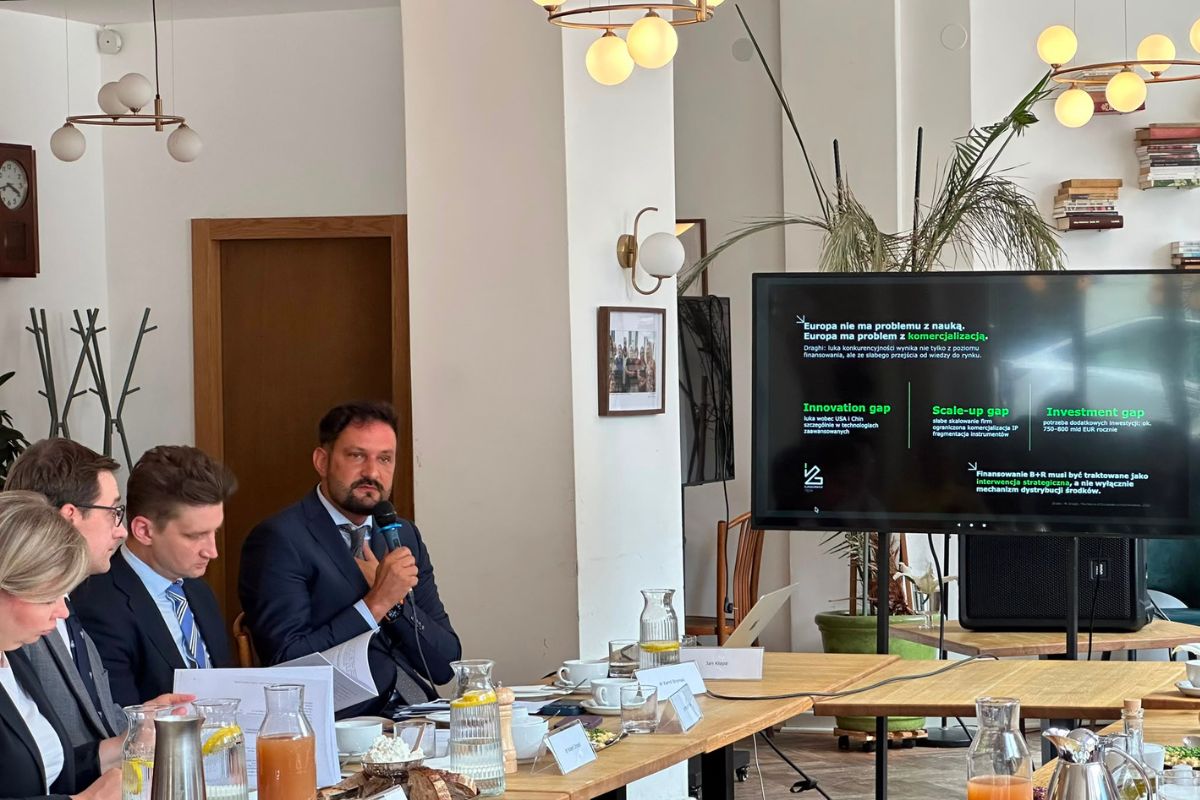
The second presentation,Competitiveness 2.0: From Project Funding to Strategic Impact, was delivered by Kamil Bromski, PhD, from the Centre for Technology Assessment and Development at Łukasiewicz – ITECH.
His presentation focused on how public support for innovation is evaluated. According to Łukasiewicz – ITECH experts, one of the main weaknesses of current evaluation systems is their emphasis on accountability, fund absorption and formal delivery indicators. Such measures do not always answer the more fundamental question: what tangible difference has public funding made to a company, a programme or the innovation system as a whole?
Against this backdrop, the presentation introduced the Commercialisation Compass, a tool being developed by the Analysis and Technology Development at Łukasiewicz – ITECH to support a more systemic assessment of innovation funding. The framework is designed to bring together data on state aid, company finances, patents and market performance, while applying counterfactual analysis at company, programme and system level.
The Commercialisation Compass shifts the focus from asking, “How much was spent?” to asking, “What difference did that spending make?” This approach makes it possible to assess more effectively whether public support is genuinely helping businesses grow, strengthen their technological capabilities, commercialise R&D outcomes and generate lasting economic value.
A key strength of the Compass is its ability to assess performance at several levels. The first compares successful and unsuccessful applicants within the same funding call, helping to determine the additional impact generated by public support. The second compares successive calls under the same funding instrument, for example different rounds of the SMART Path programme. This makes it possible to examine how changes in assessment criteria, funding allocations, programme structure or beneficiary profiles affect results. The third level compares instruments introduced under different EU funding periods, such as the Fast Track and SMART Path programmes. At this stage, the focus moves beyond individual projects or calls to the effectiveness of the intervention model as a whole. In this way, the Compass can show whether a redesigned funding instrument leads to greater patenting activity, more market launches, faster export growth or more durable outcomes after public funding has ended.
Local Content and a New Approach to Innovation
The meeting concluded with an hour-long discussion held under the Chatham House Rule, focusing on the implications of both publications. Participants agreed that strengthening Poland’s innovation ecosystem will require more than higher levels of investment. It will also demand a more coherent, long-term strategy aligned with the needs of the economy.
Among the main barriers identified were a funding system still dominated by grants, the limited use of market-based instruments, gaps in commercialisation expertise, companies’ low appetite for risk and their limited capacity to adopt and scale innovative solutions.
Another important theme was the need to strengthen local content by increasing the role of Polish products and services and creating the conditions for domestic companies to participate meaningfully in major development projects. Participants stressed that securing a stronger position for Polish businesses within value chains is essential to building lasting economic competitiveness.
Innovation Must Deliver for the Economy
Strengthening Poland’s innovation ecosystem requires coordinated action on several fronts: increasing R&D investment and targeting it more effectively, deepening cooperation between research and business, building stronger commercialisation capabilities, and developing tools that can measure the real economic impact of public funding.
The expert breakfast formed part of a regular series of events organised by the Łukasiewicz – ITECH Institute of Innovation and Technology, bringing together representatives from academia, business, think tanks, NGOs and the public sector. Future meetings will focus on the most pressing challenges facing the Polish economy, particularly in the areas of security and defence, the energy transition and technological development.
The key question is no longer simply how much Poland should invest in innovation. Increasingly, it is how that investment should be designed so that innovation makes a tangible contribution to competitiveness, resilience and long-term economic growth.