/ PUBLICATIONS
Policy Brief: “The Volatile Taiwan Strait: Economic Security Perspectives from Central Europe”
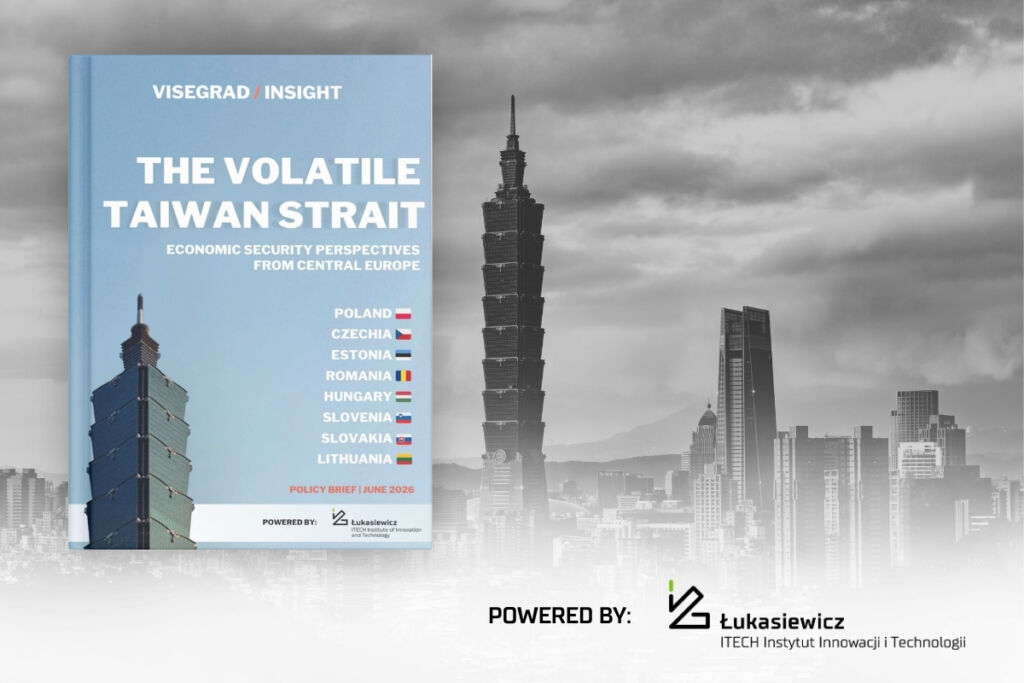
The economic security of our region is rarely so strongly determined by events taking place 9,000 kilometers away. For the countries of Central and Eastern Europe, the stability of the Taiwan Strait is not just a matter of geopolitics—it is a real, everyday foundation for the availability of key components on which the efficiency of our factories, power grids, and healthcare systems depends.
The Łukasiewicz – ITECH and Visegrad Insight think tanks have produced a publication titled “The Volatile Taiwan Strait: Economic Security Perspectives from Central Europe.” It represents a joint research effort that integrates political, expert, and business perspectives. An interdisciplinary team of authors has created a comprehensive map of the economic and technological interdependencies between the CEE region and Taiwan and outlined the potential consequences of various scenarios involving escalating tensions in the Taiwan Strait.
Data as the Foundation of Resilience
Modern strategy requires thinking that goes beyond short-term reactions. The analysis employs the strategic foresight method, which allows us to examine the situation in the Taiwan Strait through the lens of four escalation scenarios: ranging from gray-zone pressure to full-scale conflict. An analysis of trade flows in recent years —covering imports of Taiwanese semiconductors and electronic equipment to countries in our region—provides hard evidence of just how deeply our economies have integrated with Taiwan’s high-tech ecosystem. Understanding these nuances is essential to accurately assess the true extent of interdependence between Central and Eastern Europe and Taiwan.
Partnership in Support of Resilience
In the foreword to the document, Dr. Michał Matlak, Director of Łukasiewicz – ITECH, highlights the essence of this partnership:
“Taiwan is both a critical source of strategic technologies and an example of democratic resilience, offering valuable lessons for countries in our region.”
The conclusions drawn from this study are clear: for policymakers and business leaders, building long-term economic resilience requires implementing a strategy based on knowledge and risk anticipation. This publication serves as an important starting point for this discussion, outlining specific courses of action—from diversifying supply chains to developing expertise inresilience technology.
The full text of the policy brief is available below.