On June 23, 2026, the Staszic Palace in Warsaw will host an expert conference titled “10 Years After the Brexit Referendum: Lessons for Poland and the European Union,” co-organized by Łukasiewicz – ITECH and the Department of European Studies at the Institute of Political Studies of the Polish Academy of Sciences.
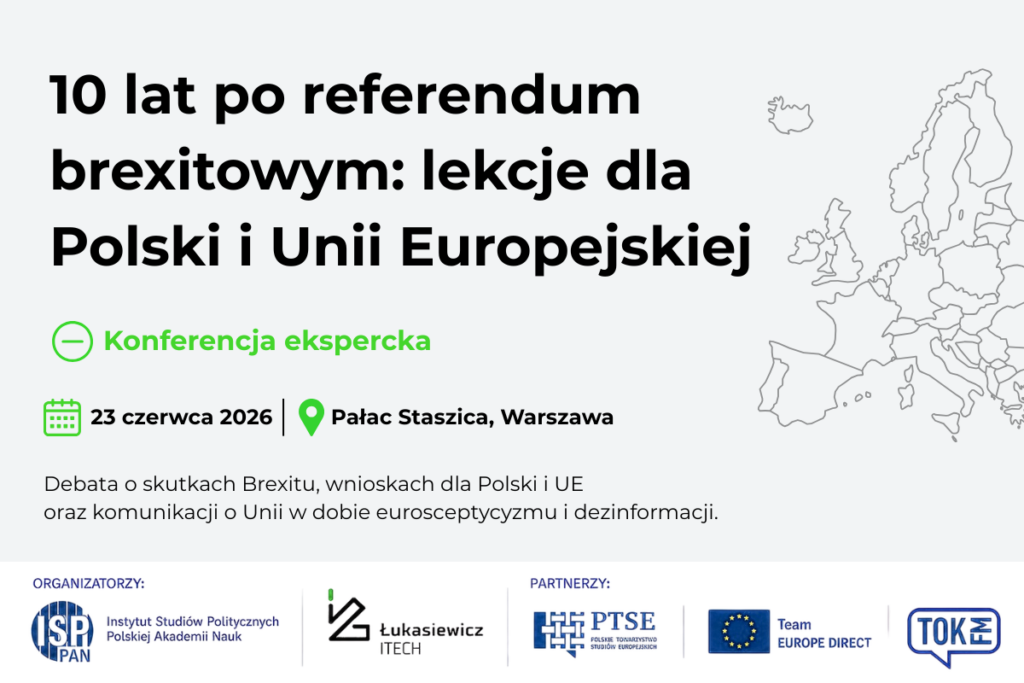
⇒ The event will provide an opportunity to discuss the political, economic, and social consequences of Brexit, as well as what lessons Poland and the European Union can learn from the British experience.
⇒ A decade ago, a referendum on the United Kingdom’s membership in the EU ended with a result that came as a shock to many: 51.9% of voters chose to leave the Union. This decision marked the beginning of a long and arduous formal process that would bring an end to London’s 43-year membership in the European project. This decision by the British public had colossal political and economic consequences and also had an impact on the security sphere.
The consequences of this move continue to resurface not only in the domestic debate within the UK, but also in discussions about the dynamics of European integration and the continent’s shared challenges. Brexit is undoubtedly a watershed moment in Europe’s recent history, as well as a source of instructive insights into Euroscepticism, populism, and the resilience of democratic societies that have hitherto been based on a certain political consensus.
We invite you to join us for an anniversary reflection at the expert conference “10 Years After the Brexit Referendum: Lessons for Poland and the European Union,” which will take place on June 23, 2026. Łukasiewicz – ITECH is co-organizing the event together with the Department of European Studies at the Institute of Political Studies of the Polish Academy of Sciences. The event will take place in the Maria Skłodowska-Curie Hall of the Staszic Palace in Warsaw.
The event program includes two expert panels. The first, “The Causes, Promises, and Outcomes of Brexit: Who Won from Leaving the EU?”, will assess the British decision and its consequences for the United Kingdom, Poland, and the entire European Union. The second panel, “Communicating about the EU in an era of rising Euroscepticism and disinformation,” will focus on how to discuss European integration in a responsible, understandable, and nuanced manner that resists the oversimplifications prevalent in public debate.
The discussion will feature representatives from the worlds of academia, diplomacy, public administration, the media, and expert communities. The panelists will include, among others, Witold Sobków, Polish Ambassador to the United Kingdom from 2012 to 2016, Małgorzata Kaczorowska from the University of Warsaw, Przemysław Biskup from the Polish Institute of International Affairs (PISM), Marta Prochwicz-Jazowska from the European Council on Foreign Relations (ECFR), Konrad Szymański, Minister for European Affairs from 2015 to 2022, Agnieszka Legucka from the Strategy Department of the Ministry of Foreign Affairs, Karolina Borońska-Hryniewiecka from the Institute of Political Studies of the Polish Academy of Sciences (ISP PAN) and Team Europe Direct, and Paweł Musiałek from the Jagiellonian Club.
Łukasiewicz – ITECH will be represented by the Director of the Strategy and Analysis Department, Dr. Paweł Marczewski, who will participate in the conference opening and moderate the first panel, and Dr. Michał Matlak, Director of Łukasiewicz – ITECH, who will speak during the discussion summary.
Event partners: Team Europe, Radio TOK FM, and the Polish Society for European Studies.